

Business idea validation is one of the most critical — and most skipped — steps in the entrepreneurial journey. Many founders rush to build before they’ve confirmed that anyone actually wants what they’re making. Here’s a structured breakdown of how to do it right.
Why Most Ideas Fail Before They Should?
The CB Insights post-mortem on startup failure is now almost a cliché in entrepreneurship education, but its findings remain sobering. The single most cited reason for startup failure — accounting for 35% of cases in their most recent analysis — is not running out of money, not hiring the wrong team, not poor execution. It is building something the market did not want. A product without a problem. A solution without a customer.
What makes this particularly instructive is that market misalignment is not an execution failure. It is a thinking failure — specifically, a failure of validation. The company ran out of evidence long before it ran out of runway. The founders were so deeply convinced by their own hypothesis that they never seriously entertained the possibility it was wrong.
This is not an indictment of ambition. Conviction is necessary for entrepreneurship. But conviction without interrogation is not confidence — it is stubbornness dressed in the language of vision. The most rigorous founders are those who are most eager to be proven wrong early, because being proven wrong early is cheap. Being proven wrong after a Series A is not.
Why validate first?
The core question is simple: Is there a real problem, and will people pay you to solve it? Validation is the process of gathering evidence to answer that question before investing significant time or money. It’s the bridge between “I have an idea” and “I have a business.”
What follows is not a checklist. Checklists are for people who have already decided. This is, rather, a framework for disciplined inquiry — a way of thinking about the relationship between ideas, markets, and evidence that draws on design thinking, lean startup methodology, and business model theory. It is intended for founders, R&D project managers, and innovation teams who are serious enough about their idea to want to know whether it deserves to be taken seriously.
Let’s look at the full validation journey:
The 5-stage validation journey in practice:
Stage 1 — Problem definition. Start with empathy, not assumptions. Before anything else, you need to confirm that the problem you’re solving is real, painful, and frequent. Design thinking tools like empathy maps and personas will help you dig beneath surface observations to uncover root causes.
Stage 2 — Customer segment. Not every pain belongs to the same person. Your goal here is to identify the specific group of people who feel this problem most acutely — your early adopters. Customer discovery interviews (a lean startup staple) are the gold standard at this stage. Talk to at least 8–10 people before drawing any conclusions.
Stage 3 — Solution fit. Once you understand the problem and the customer, test whether your proposed solution fits. This is where the Value Proposition Canvas is invaluable — it maps customer jobs, pains, and gains against your solution’s features and benefits. Build the simplest possible prototype and put it in front of real users.
Stage 4 — Market demand. Even a perfect solution to a real problem can fail if the market is too small or too competitive. Conduct a market sizing exercise (TAM → SAM → SOM), map the competitive landscape, and look for your differentiation angle.
Stage 5 — Business model. This is where most entrepreneurs hesitate. The Business Model or Lean Canvas helps you stress-test your revenue model, cost structure, channels, and key partnerships. Most critically: run willingness-to-pay experiments. A landing page with a payment button, pre-orders, or a pilot customer tells you far more than a survey ever will.
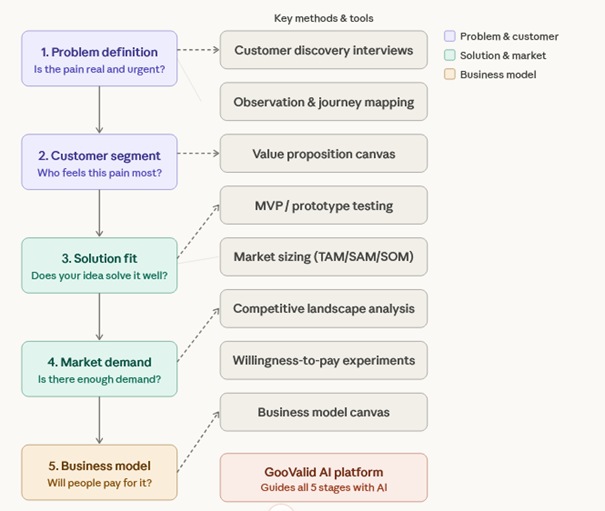
Validation is not a linear checklist — it’s a cycle. Each stage may send you back to revise your assumptions. This is the essence of the Lean Startup build-measure-learn loop: treat every assumption as a hypothesis, design the cheapest possible experiment to test it, and only invest further when the evidence supports it.
How GooValid Support Business Idea Validation Process?
Platforms like GooValid are designed precisely for this context: to make structured, evidence-based validation accessible to founders at the earliest stages of their journey, regardless of their prior experience with lean methodologies or business model design. The platform guides users through each of the five validation dimensions, poses the questions that experienced practitioners would ask, and helps interpret the evidence that emerges.
Below is how GooValid strengthens business idea validation with its own stages harmonized with Design Thinking and Lean Startup:
🔷 Stage 1 – Conceptual Vision
(Market, Environmental, and User Analysis)
At this stage, entrepreneurs often rely on intuition or scattered research. GooValid transforms this into a structured analytical process:
- Guides users through Market Analysis and PESTLE (Environmental Analysis) with AI-supported inputs
- Helps identify target segments, trends, and external forces systematically
- Generates initial hypotheses about users, problems, and opportunities
👉 Instead of “I think there is a market,” you get evidence-backed opportunity framing.
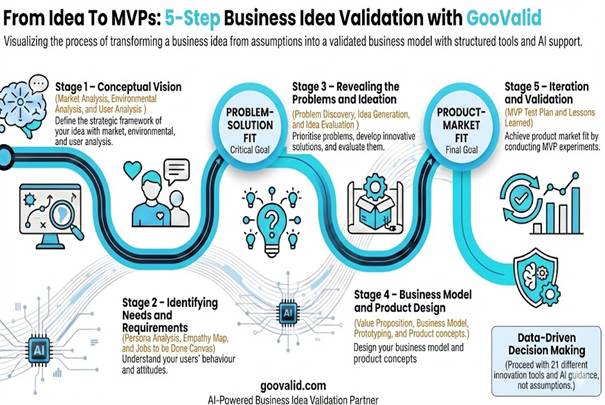
🔷 Stage 2 – Identifying Needs and Requirements
(Persona, Empathy Map, Jobs to Be Done)
Understanding users deeply is one of the hardest parts of validation. GooValid acts as a cognitive assistant:
- Builds final Personas based on your inputs
- Generates Empathy Maps to uncover emotional and behavioral drivers
- Structures Jobs to Be Done (JTBD) to clarify what users are truly trying to achieve
👉 This ensures you don’t just define users—but understand their motivations, pains, and expectations in depth.
🔷 Stage 3 – Revealing Problems and Ideation
(Problem Discovery, Idea Generation, Evaluation)
Many teams jump to solutions too quickly. GooValid enforces disciplined thinking:
- Uses tools like 5WH, Fishbone Diagram to uncover root causes of problems
- Supports SCAMPER and Six Thinking Hats for structured ideation of defined root problems
- Applies Impact–Effort analysis to prioritize the most promising ideas
👉 The result is not just ideas—but validated problem–solution alignment (Problem–Solution Fit).
🔷 Stage 4 – Business Model and Product Design
(Value Proposition, Business Model, Prototyping)
This is where ideas become tangible. GooValid integrates multiple frameworks:
- Helps create a Value Proposition using structured logic (e.g., Buyer Utility Map)
- Builds a Lean Canvas aligned with previous insights
- Supports concept development and prototyping decisions
👉 Unlike isolated tools, GooValid ensures your business model is fully consistent with validated user insights.
🔷 Stage 5 – Iteration and Validation
(MVP Test Plan and Lessons Learned)
Validation is incomplete without real-world testing. GooValid operationalizes this phase:
- Guides you in creating an MVP Test Plan (hypotheses, metrics, target users)
- Structures Validation Interviews and feedback collection
- Captures insights through a Lessons Learned framework
👉 This enables continuous iteration, moving from assumptions to measurable validation and ultimately Product–Market Fit.
Conclusion: The Courage to Be Wrong Early
Entrepreneurship literature celebrates resilience, but it does not always celebrate its precondition: the intellectual honesty to find out early that you are wrong, so that you can correct course before the cost of being wrong becomes prohibitive.
Business idea validation is, in the end, an act of courage disguised as a methodology. It requires you to care enough about your idea to test it seriously — to subject it to the scrutiny of real customers, real markets, and real evidence — knowing that what comes back might not be what you hoped for. And it requires you to trust that what comes back, whatever it is, makes you a better entrepreneur than you were before.
The founders who build things people actually want are not the ones who had better ideas. They are the ones who asked better questions.